


Last updated 8 September 2026 · Originally published 31 July 2021
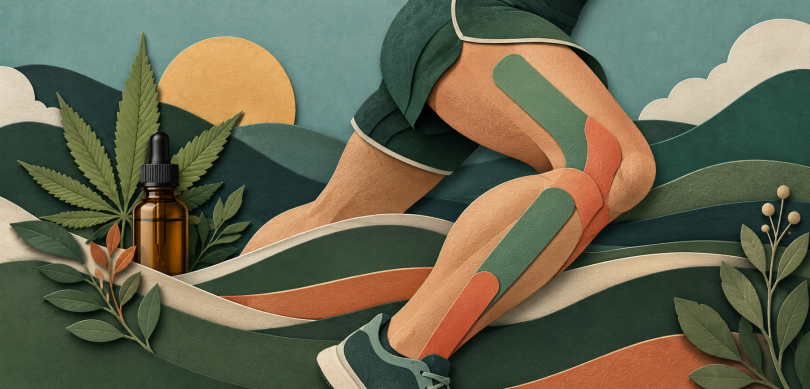
CBD athletic tape is kinesiology tape — the bright elastic strips you see across athletes’ shoulders and knees — with CBD in the adhesive. It sells on a simple pitch: the tape supports the muscle, the CBD calms it, “dual action”. It is two products with thin evidence apiece, sold as if combining them added something. Nobody has tested whether it does. Here is what each half actually shows, and what to make of the pair.
The tape half
Kinesiology tape took off after the 2008 Olympics and is now a familiar sight across sport. What it does beyond feeling supportive is genuinely unsettled: reviews and trials keep finding small, inconsistent effects on pain and none worth counting on for strength or performance. One particularly neat test of the performance claims: a 2018 trial tested tape against no tape, sham taping, and — because marketers claim colours matter — red versus blue. Thirty-two people, hop tests, strength measures, brain stimulation to check muscle activation. The tape did nothing measurable, in any colour. These were healthy people doing performance tests, so the trial cannot settle whether taping relieves pain in injured athletes — but the performance claims did not survive it.
That does not make taping worthless. Plenty of athletes find it comfortable, it may make an area feel supported, and feeling supported is worth something. But the mechanical half of “dual action” is already a maybe.
The CBD half
CBD applied to the skin mostly remains in or near the skin, and delivery depends heavily on the formulation. In small placebo-controlled studies, including a double-blind trial of a CBD ointment applied repeatedly after a muscle-damaging workout, topical CBD has produced no consistent benefit for soreness, swelling, muscle damage or performance. That does not prove every CBD topical is ineffective, but it gives little reason to expect CBD in tape adhesive to improve recovery.
The better news for CBD is oral: small swallowed-CBD studies at 17 to 67 mg — the one research area whose doses overlap what shops sell — have found some reduced soreness and better recovery of performance, alongside null results. Mixed, small, but not nothing. None of it involved tape.
The combination nobody has tested
We could not find a single study of CBD-infused tape — not for soreness, not for recovery, not even one measuring whether CBD gets out of the adhesive and through the skin. That last question is not a technicality. A cream is a formulation designed to carry CBD into skin; delivery depends heavily on the vehicle, and a dry adhesive worn for days is a very different vehicle from a cream, in ways nobody has measured in either direction. Most tape products do not even state a CBD dose per strip. So every claim on the packaging — “calms inflammation”, “reduces lactic acid buildup”, “faster recovery” — is an extrapolation from studies of other products, stretched over a product with no studies. The lactic acid one is not even good extrapolation; it is a gym myth with CBD stuck to it.
One thing competitive athletes should check
Under the World Anti-Doping Agency’s list, CBD is the only cannabinoid permitted; every other natural or synthetic cannabinoid is prohibited in competition. That means a full-spectrum product is a risk by design — not just for its THC, but for the other cannabinoids that make it full spectrum. Tape brands lean on “no banned substances”, but that claim is only as good as the product’s testing, and mislabelling is common across CBD products. A tested athlete using cannabinoid tape should treat it like any supplement — demand a current, batch-specific certificate of analysis, know that a COA or sports certification reduces the risk without guaranteeing against a positive test, and know that “hemp-derived” is not a defence at a doping hearing.
The honest verdict
If you like taping, tape — it is low-risk and the support may help you feel and move better, which is not nothing in sport. But you are paying a premium for the CBD in it, and that premium buys you an untested delivery method for a compound whose topical evidence is already thin. Oral CBD has at least been studied for exercise recovery, with small and inconsistent results; CBD delivered through athletic tape has not been studied at all. And if a strip does make your shoulder feel better, possible explanations include the physical sensation of the tape, warmth, reassurance and natural recovery.
One practical note: tape adhesives can irritate or pull at the skin. Do not apply the tape over broken skin, and remove it if it causes burning, itching or a rash.
Nothing in this article is medical advice. A persistent sports injury deserves a physiotherapist or doctor, not a taping strategy.