


Last updated 9 August 2026 · Originally published 12 August 2019
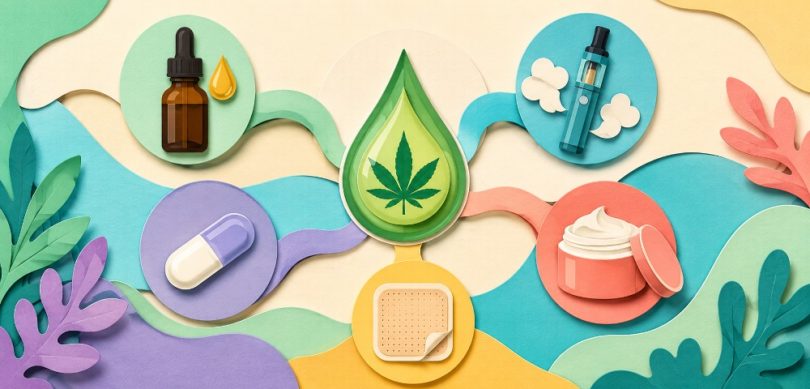
Oil under the tongue, a capsule, a gummy, a vape, a cream. They all deliver CBD, but not in the same amounts and not on the same timescale.
Here’s what actually differs between them — including one claim that has much less evidence behind it than product labels suggest.
The thing that decides everything
Two questions matter: how much of the CBD reaches your bloodstream, and how fast.
Swallow something and it goes through your digestive system and then your liver, which breaks down most of it before it ever reaches circulation. That’s called first-pass metabolism, and it’s why oral CBD is inefficient.
CBD absorbed through the lungs bypasses that first pass. CBD absorbed through the lining of the mouth would too — but as we’ll see, ordinary oil may not be absorbed there in meaningful amounts.
Inhaling
Among the common consumer routes, inhaling raises CBD blood levels fastest — usually within minutes. One small older study estimated bioavailability after smoking at around 31%.[2] There’s no equally reliable figure for swallowed CBD in humans, though absorption is clearly slow, low and highly variable.
Vaping also carries risks unrelated to CBD itself. It exposes the lungs to an aerosol, and poorly regulated cartridges may contain contaminants or unsuitable additives. The 2019 outbreak of vaping-related lung injury was associated mainly with informal THC products containing vitamin E acetate, rather than CBD specifically.[3]
Under the tongue
Here’s where the standard advice runs ahead of the evidence.
The theory: hold oil under your tongue for a minute and some of it absorbs through the lining of your mouth, bypassing first-pass metabolism. Faster onset, more of it gets through.
Some absorption through the mouth may happen. But the evidence that ordinary CBD oil works efficiently this way is surprisingly weak.
In a small 2024 crossover study of eight healthy men, CBD drops placed under the tongue and CBD capsules swallowed whole produced very similar blood levels, both peaking at around four hours.[1] If substantial sublingual absorption had occurred, you’d expect the drops to peak sooner.
That suggests most of the oil was swallowed before much could cross the membrane. It doesn’t prove every sublingual formulation behaves the same way, but it does mean the word “sublingual” doesn’t guarantee faster or greater absorption.
None of which makes tinctures pointless. Even if most of the oil is eventually swallowed, it still delivers an oral dose in a particularly flexible form. A graduated dropper lets you adjust the amount in small increments, oils suit people who dislike swallowing capsules, and they’re often cheaper per milligram than gummies.
What the study questions is the promise of reliably faster or greater absorption — not the usefulness of the oil itself. Don’t assume “sublingual” automatically makes a tincture stronger, and don’t pay a premium for that claim alone.
Swallowing
Capsules, gummies and drinks — anything you swallow. Absorption is slow and highly variable. Blood levels commonly peak several hours after a dose, and sometimes considerably later when CBD is taken with food. And because CBD is non-intoxicating, there may be no obvious moment when it “kicks in”.
What you get in exchange is convenience. A capsule provides a fixed, premeasured serving — assuming the product is accurately labelled — needs no measuring, doesn’t taste of anything, and travels without leaking. For anyone taking a consistent daily amount, that’s a reasonable trade.
One important complication is food. Eating, particularly a fatty meal, can increase CBD absorption dramatically — pharmaceutical CBD exposure rises several-fold with a high-fat meal.[4] So the same capsule may produce very different blood levels depending on when you take it.
If you use CBD regularly, take it consistently in relation to meals rather than switching between an empty stomach and a large dinner. Anyone on prescription CBD should follow its dosing instructions.
On the skin
Creams, balms and salves are intended mainly to work where you put them — a specific sore knee, not anxiety. How much CBD penetrates the skin, or reaches the bloodstream, varies enormously with the formulation, and the evidence that ordinary retail topicals relieve pain or skin conditions remains limited.[5]
Formulation matters more than the milligram count. Our guide to CBD cosmetics covers that, and our piece on topicals goes through which conditions they suit.
Transdermal patches aim to do something different, despite often being lumped in with topicals. They’re designed to carry CBD through the skin and into circulation, producing effects beyond the application site. Whether a particular retail patch achieves that is another question — “transdermal” describes what it’s meant to do, not a guaranteed result. We look at those separately.
So which should you pick?
Less about which is best, more about what you want it to do.
Something specific and localised — a sore joint, a patch of skin. A topical is the route designed for that, though the evidence for ordinary retail products remains limited.
Fast onset — inhaling, with the caveats above.
A steady daily amount — capsules or gummies. Take them consistently in relation to meals.
Fine control over your dose — oil with a graduated dropper. It’s the easiest format to adjust in small increments, whether you hold it under your tongue or simply swallow it.
Two things worth knowing whichever you choose
Milligrams per serving, not per bottle. “1,000 mg” on the front tells you nothing until you know how many doses that covers.
The route doesn’t rescue a weak dose. Switching from a capsule to a tincture won’t turn 10 mg into the 300–600 mg used in some clinical studies. That’s worth knowing before concluding CBD does nothing for you — but it isn’t an argument for simply taking more, either. Higher doses raise the chance of side effects and drug interactions, and they don’t reliably work better.
None of this is medical advice.
For more, see how long CBD stays in your system, our guide to what the research actually shows, or browse Using CBD.
References
- Johnson DA, Funnell MP, Heaney LM, et al. Cannabidiol oil ingested as sublingual drops or within gelatin capsules shows similar pharmacokinetic profiles in healthy males. Cannabis and Cannabinoid Research. 2024;9(5):e1423–e1432. doi:10.1089/can.2023.0117
- Millar SA, Stone NL, Yates AS, O’Sullivan SE. A systematic review on the pharmacokinetics of cannabidiol in humans. Frontiers in Pharmacology. 2018;9:1365. doi:10.3389/fphar.2018.01365
- Blount BC, Karwowski MP, Morel-Espinosa M, et al. Evaluation of bronchoalveolar lavage fluid from patients in an outbreak of e-cigarette, or vaping, product use-associated lung injury. MMWR. 2019;68:1040–1041. doi:10.15585/mmwr.mm6845e2
- Taylor L, Gidal B, Blakey G, et al. A Phase I, randomized, double-blind, placebo-controlled, single ascending dose, multiple dose, and food effect trial of highly purified cannabidiol in healthy subjects. CNS Drugs. 2018;32(11):1053–1067. doi:10.1007/s40263-018-0578-5
- Scholfield CN, Waranuch N, Kongkaew C. Systematic review on transdermal/topical cannabidiol trials. Cannabis and Cannabinoid Research. 2023;8(4):589–602. doi:10.1089/can.2021.0154
About this article
Substantially rewritten in August 2026, consolidating our earlier reporting on how to take CBD. This update adds the 2024 study comparing sublingual drops with capsules, corrects the common claim that transdermal patches work like topicals, and explains why taking oral CBD with food matters. With earlier reporting by Lisa Rennie.