

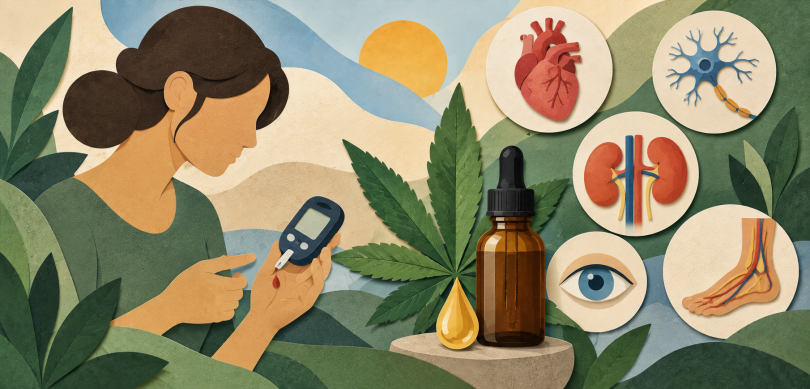

Short answer: pure CBD has not been shown to lower blood sugar in people. When it comes to CBD and diabetes, most of what we have is cell and animal research, plus a handful of small human trials with mixed results — several of which tested CBD alongside THCV or THC, not CBD by itself.
There’s one exception worth flagging up front: the evidence for diabetic nerve pain is a bit more encouraging than the evidence for blood sugar itself. But relieving pain isn’t the same as treating diabetes or reversing nerve damage, and diabetes is a serious, medically managed condition either way. Nothing below changes that.
What cells and animals show
Type 2 diabetes causes ongoing damage to blood vessels, driven partly by inflammation from chronically high blood sugar. In a 2007 lab study, CBD was applied directly to human coronary artery endothelial cells — the cells lining blood vessels — exposed to high-glucose conditions. CBD reduced several markers of that damage: oxidative stress, the inflammatory signal NF-κB, the adhesion molecules that let immune cells stick to vessel walls, and breakdown of the vessel lining itself. That’s a cell-culture finding, not a person or even an animal, and it points to a mechanism that might matter for vascular complications, not a treatment effect anyone has observed in a body.
On prevention, a mouse study is often cited and deserves a precise summary. In NOD mice, a strain genetically prone to autoimmune (type 1-pattern) diabetes, only 32% of CBD-treated mice developed diabetes, compared with 86% of vehicle-treated controls and 100% of untreated mice — a substantial reduction in a specific, well-established mouse model. That research measured disease incidence, pancreatic inflammation, and immune markers; it did not include a separate test of CBD’s direct effect on blood glucose, so nothing here should be read as CBD “not affecting glucose” — that particular experiment simply wasn’t part of this study. Whatever is happening looks like an effect on the immune process behind this specific type of diabetes, in a mouse strain bred for exactly this susceptibility — not evidence about diabetes generally. Worth keeping in mind, too: many interventions that have prevented diabetes in NOD mice have subsequently failed in human trials, so even a large effect in this model is a starting point for research, not evidence of prevention in people.
Diabetic nerve pain (neuropathy) has animal evidence too: in diabetic rats, CBD reduced mechanical allodynia — pain triggered by touch that shouldn’t normally hurt — through a serotonin receptor rather than the cannabinoid receptors CBD is usually associated with. Animal evidence, not human, and it doesn’t establish a dose or protocol for a person.
What happened in human trials
The longest-standing human trial is a small 2016 pilot of 62 people with type 2 diabetes, testing CBD and THCV — a different cannabinoid that was non-intoxicating at the 5 mg twice-daily dose used — against placebo, published in Diabetes Care. Its primary outcome was change in HDL cholesterol, and that didn’t improve on either compound.
The more interesting results were secondary. THCV improved fasting glucose and a marker of pancreatic beta-cell function, both significant versus placebo. CBD alone did not improve fasting glucose or HbA1c. Neither compound changed appetite, despite that claim circulating elsewhere. And combining CBD with THCV produced no significant benefit over placebo — which doesn’t prove CBD blocked THCV’s effect, only that the combination didn’t reproduce it.
Two more recent trials add real but limited data. A 2022/2023 trial gave 50 people with type 2 diabetes a proprietary 10:1 CBD-to-THC spray for eight weeks. Fasting glucose and HbA1c improved versus placebo, along with several lipid markers. Curiously, the reported daily dose was only 0.4 mg of CBD and 0.04 mg of THC — far below a typical consumer serving, which makes the result particularly hard to interpret. The finding hasn’t been independently replicated, and because the product contained both cannabinoids, it can’t be credited to CBD alone.
A 2026 pilot points the other way: 16 overweight or obese adults without diabetes took 60 mg of CBD alone daily for four weeks, with no improvement in glucose tolerance, inflammation, or the gut microbiome. It’s a very small study, and not in people with diabetes — but it’s still relevant human evidence that plain CBD, on its own, hasn’t shown the glucose-lowering effect sometimes implied for it.
What about diabetic nerve pain?
Human evidence here is thin, but somewhat more encouraging than for glucose control.
A 2021 trial gave 54 people with painful diabetic peripheral neuropathy 60 mg of proprietary sublingual CBD daily, or placebo, for 28 days. Pain fell significantly more with CBD than with placebo, with average scores in the CBD group dropping by roughly half. The trial was short and conducted remotely; it was entirely financed by the manufacturer, all three authors were associated with the company, and pain was a secondary outcome. It needs independent replication — but it’s a real result, and it belongs in the picture. Pain relief also wouldn’t mean the nerve damage had healed, so foot checks, glucose management, and prescribed neuropathy care would still matter regardless.
A separate, larger trial gave 100 people with diabetic neuropathy a transdermal cannabis preparation and found a large reduction in pain. That preparation, though, was THC-dominant, with CBD and CBN mixed in at much lower concentrations. The study’s own authors credit THC as the main driver — so this one can’t tell us whether CBD specifically was responsible.
The short version
CBD has not been shown to control diabetes. Pure CBD failed to improve fasting glucose or HbA1c in the main diabetes trial, and a later pilot found no improvement in glucose tolerance. Other small studies have reported signals from THCV or CBD-THC products, while early trials suggest CBD or mixed-cannabinoid preparations may reduce diabetic nerve pain. None of that supports replacing insulin, metformin, or any other prescribed treatment. CBD can also interact with some medicines commonly taken by people with diabetes, depending on the specific drug — see our CBD drug interactions guide.
This isn’t medical advice, and it especially isn’t a reason to change how you manage diabetes. If you have diabetes and are considering CBD, talk to your endocrinologist, primary care provider, or diabetes care team first — they know your medications, your numbers, and your risks in a way this article can’t.