

Last updated 26 August 2026 · Originally published 17 February 2021
“Minor cannabinoids” is a catch-all name for cannabinoids other than THC and CBD: CBG, CBN, CBC, THCV and a long tail of others, most normally present in tiny amounts. Products built around them promise focus, sleep, appetite control and more, usually on the strength of laboratory work. This guide says what each one is, what is claimed for it, and how much of that has been tested in people. “Minor” describes how much is normally present in the plant. It does not mean weaker, safer or non-intoxicating. Where we have a full article on a cannabinoid, it is linked.
How they are related
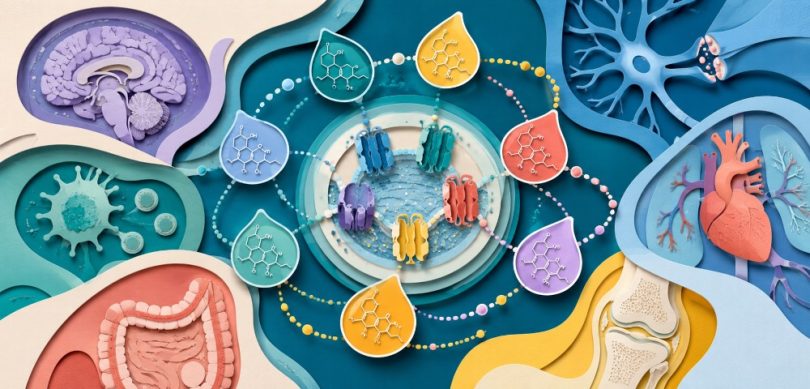
Most cannabinoids begin in one of two related pathways. CBGA is converted into the acid forms of THC, CBD and CBC, while a close relative, CBGVA, leads to THCV, CBDV and the other “varin” cannabinoids, shorter versions of THC and CBD. Heat converts the acids into their neutral forms, which is how THCA becomes THC and CBDA becomes CBD. CBN is different: it forms mainly as THC ages and oxidises.
That matters in two practical ways. Fresh cannabis contains mostly the acid forms, while heating converts much of them into the neutral forms. Drying and storage cause some conversion too, so real products commonly contain both, and the two are not interchangeable. And because most of these are present at under 1% of the plant, products built around them are either bred from unusual varieties, concentrated from ordinary ones, or made by fermentation or in a lab.
CBG
CBG forms when leftover CBGA loses its acid group, usually through heat. It is sold for focus, mood and gut health and is not intoxicating. Human evidence is still small: a 34-person trial found that 20 mg reduced anxiety and stress, while a later sleep trial found no clear advantage over placebo. A 12-person safety study found single doses up to 200 mg generally well tolerated. None of that establishes CBG as a treatment. Is CBG the new CBD? goes through it.
CBN
CBN forms as THC breaks down while cannabis ages. It is sold almost entirely for sleep and is not generally intoxicating on its own. The evidence is a handful of small trials with mixed results, most of them funded by the companies selling it, and no good reason yet to think CBN works better than a placebo for most people. Two articles cover it: CBD vs CBN and CBN and sleep.
CBC
One of the better-known minor cannabinoids, generally present at low levels in modern products, and little studied. It is claimed to help with pain, inflammation, mood and acne. Every one of those claims rests on cell or mouse studies. We could not find a controlled human trial testing CBC itself as a treatment. It does not produce a high.
CBDA and THCA
The raw, unheated forms of CBD and THC. THCA does not produce a THC-like high, but heat rapidly converts it into THC, and slower conversion during drying and storage means a nominally raw product may already contain some THC. CBDA is absorbed from the gut considerably better than CBD. In laboratory studies it affects COX-2, an enzyme involved in inflammation, and in animals it has shown anti-nausea and anti-anxiety effects. THCA is claimed to be anti-inflammatory and to protect nerves. Both have now been measured in small human pharmacology studies, but none of those effects has been demonstrated as a treatment in people. They matter for buyers because a product’s certificate of analysis reports them separately from CBD and THC. Check whether a label means CBD itself or “total CBD”, which includes the CBD that CBDA could become after conversion.
THCV
A shorter relative of THC, sold for appetite control, energy and focus, with “diet weed” as the nickname. In a 2016 five-arm pilot trial of 62 people with type 2 diabetes, the group receiving THCV alone took 5 mg twice a day. Their fasting blood sugar fell compared with placebo, but their appetite and body weight did not. Other small human studies have produced limited or mixed findings. In small studies, doses around 10 mg a day did not produce noticeable intoxication, while mild drug effects have been reported after much larger single doses of 100 to 200 mg.
Delta-8 THC
Sometimes called a minor cannabinoid because the plant contains it naturally in trace amounts. Most commercial delta-8 is instead made by chemically converting CBD. It is intoxicating, can impair driving, and belongs with THC products rather than with non-intoxicating cannabinoids like CBG and CBC.
The rest
CBDV, CBGA, CBL, CBT and dozens more. CBDV has been tested in people for epilepsy and autism with disappointing results. For the others, the evidence is somewhere between a few cell studies and nothing.
Terpenes and the entourage effect
Terpenes are not cannabinoids, but they travel with them, and the claim that the whole mix works better than any single compound — the entourage effect — usually rests on them. It remains a hypothesis: two small human trials have tested specific terpene-THC combinations, with one positive and one negative result. Our terpene guide covers the common ones, and our spectrums guide covers what “full spectrum” does and does not mean.
Cancer
Several minor cannabinoids kill cancer cells in a dish, which is true of a great many compounds and is a long way from treating cancer in a person. Do the minor cannabinoids affect cancer? looks at what the laboratory work shows and why it should not be read as more than that.
Buying minor cannabinoid products
Three things. First, labelling is unreliable across this market. In a 2024 test of 202 American CBD products, funded by Jazz Pharmaceuticals, 26% did not match their claimed spectrum type and 74% were more than 10% off their stated CBD strength. Separately, a study of 80 hemp oils found that minor cannabinoid amounts were largely absent from labels altogether. The minimum, then, is a current, batch-specific COA listing the cannabinoid you are paying for, any THC, and contaminant testing. Second, “THC-free” and “non-intoxicating” are not the same claim, and a minor cannabinoid product made from cannabis can carry THC along with it — what THC-free really means explains the difference. Third, for most of these compounds, doses, side effects and drug interactions remain poorly established. If you take prescription medicines, ask a pharmacist first.
The honest summary of the field: interesting biology, thin human evidence, and marketing that is running well ahead of both. That is not a reason to dismiss the minor cannabinoids. It is a reason to buy them, if you buy them, as an experiment on yourself rather than a treatment.
Nothing in this article is medical advice.