

Last updated 8 September 2026 · Originally published 28 March 2020
In just a few weeks, life has changed dramatically for people around the world. Together we are facing a pandemic, the likes of which we haven’t experienced in modern times. While some countries are starting to get a handle on the havoc this virus has caused, others are just beginning to see its effects and scrambling to contain its spread. Many of you reading this right now may be under “shelter-in-place” or similar ordinances, with the lucky ones working remotely and others wondering how they’ll pay rent after losing their jobs.
Due to the fast pace of spread and uncertainty of severity among those infected, we all have questions. And the media is trying to keep us updated as quickly as possible, but–as we all know–misinformation spreads rapidly in the digital age. We hope you’ve come to view our publication as one that holds itself up to the highest standards of scientific integrity, as the cannabidiol (CBD) industry must combat misinformation daily.
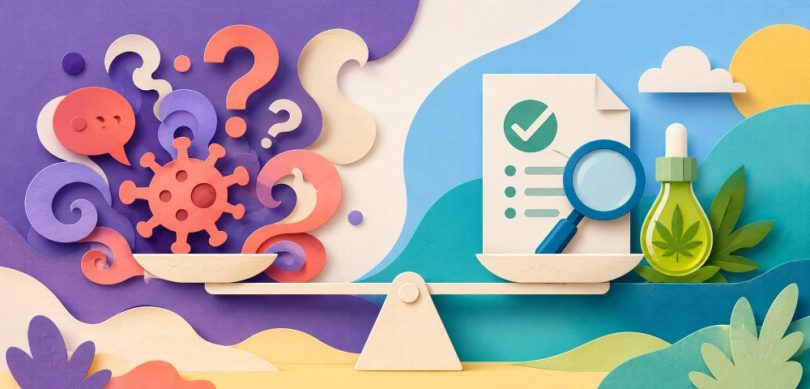
And you may have seen some CBD myths popping up as the panic over of the virus spreads–anything from the ability of CBD to “cure” COVID-19 (coronavirus disease) to CBD-infused hand sanitizers. While over hyped CBD claims are always problematic, it can be very dangerous during times like these when fear takes hold and our instincts kick in, leaving us vulnerable.
So let’s review a few basics about COVID-19 and considerations for CBD/cannabis use right now:
COVID-19 is a type of coronavirus similar to SARs. This novel coronavirus was first detected in a city of China called Wuhan, where it quickly spread to infect thousands of people within a short period of time. The virus is highly contagious and can be contracted in the air. Therefore, many governments have instituted “social distancing” measures, which may include keeping a space of six feet from others to slow the spread.
Symptoms of infection include fever, shortness of breath, and coughing. While the majority of people recover after contracting the virus, some will experience a more severe condition, which can result in death. It is currently unknown why certain people react differently to the virus but it appears that older people and those with underlying medical conditions are at higher risk of severe symptoms and acquiring secondary infections.
There are no approved treatments that can cure COVID-19. While several clinical trials have recently been initiated, these studies will take months to evaluate medications. Therefore, if you think you may have contacted the virus or experience symptoms, it’s important to follow the CDC’s guidelines. You should not try to “cure” yourself at home with any medications mentioned in the news–including CBD.
CBD holds multiple beneficial properties that make it suitable to treat many different conditions. Therefore, if you are a CBD or cannabis user, there is no reason to discontinue treatment at this time–but there’s also no evidence that using CBD will prevent you from getting infected or treat your condition alone.
However, if you are using CBD or cannabis for other reasons, it’s important to let your healthcare provider know.
CBD and cannabis are broken down in the liver through a metabolite called CYP450. Various other medications are also broken down in this manner, meaning that CBD or cannabis could increase or decrease the effectiveness of those medications–that’s why we always encourage people to be honest with their healthcare provider so they understand how your CBD or cannabis use may react with other treatments.
As COVID-19 causes significant respiratory symptoms, you may want to consider different methods of CBD or cannabis consumption if you are a regular smoker. Even if you are symptom-free, it’s important to keep your lungs as healthy as possible. So it might be a good time to explore use of alternatives like edibles or topicals.
As businesses began to shutter in the face of lockdown, stores where you buy CBD may have opted to close temporarily. The good news is that many cities/states have deemed cannabis as an “essential” business, meaning that dispensaries can stay open. If you are unable or prefer not to venture out, contact your local dispensary or store to see if they deliver. Many different CBD brands can be ordered online as well–just remember to follow the usual guidelines when buying CBD.
Under more normal life conditions, CBD can greatly help alleviate anxiety and sleep problems. So it will likely provide greater relief now during a period of extreme distress. Daily CBD use may also help boost your immune system, since it possesses anti-inflammatory properties, thus keeping your body in balance.
Right now things are tough. We’re all looking for answers and swimming in choppy waters of uncertainty. But remember to be a savvy consumer and ignore misinformation on CBD. It is not a “cure” for COVID-19–but it may help alleviate anxiety and sleep problems associated with processing this pandemic.
Be well and take one day at a time. And, as always, tell your healthcare provider if you have started or are taking CBD or cannabis so they can provide you with the best care possible.
What happened since
CBD and Covid research did produce one real finding worth naming precisely, and one honest dead end, in the years after this article was first written.
In January 2022, a team led by Richard van Breemen at Oregon State University published a study in the Journal of Natural Products reporting that two cannabinoid acids — CBDA and CBGA, the raw forms cannabis makes before heat turns them into CBD and CBG — bound tightly to the spike protein SARS-CoV-2 uses to enter human cells. In follow-up tests, at laboratory concentrations, the two acids stopped the live virus, and the Alpha and Beta variants circulating at the time, from infecting human cells in a dish — concentrations the study did not establish that a consumer product could reproduce in the body. That is exactly what it sounds like: a real, carefully done laboratory binding study. It is not a treatment, a prevention, or a finding in an animal or a person, and it was widely reported as far more than it was. Van Breemen himself cautioned that resistant variants could still emerge and that vaccination remained essential — the part of his own quote that most coverage left out.
What happened in people was less encouraging. In the randomized, double-blind CANDIDATE trial, 91 people with mild-to-moderate Covid-19 received either 300 mg of CBD daily or placebo for 14 days. CBD did not shorten the illness, prevent it worsening, or improve the study’s other outcomes. The trial did not test CBDA or CBGA, but it showed no benefit from CBD itself. The honest record, four years after the lab finding above, is one interesting cell-culture result for CBDA and CBGA, and one negative controlled trial of CBD in people. CBD has not been shown to prevent or treat Covid-19.
The bigger question behind both of these — is CBD antiviral at all — has a similarly honest, self-contained answer. Laboratory studies over the years have reported activity for various cannabinoids against various viruses, including hepatitis C, herpes and now SARS-CoV-2. No controlled human trial has shown that CBD, CBDA or CBGA prevents or treats a viral infection. Laboratory studies remain reasons to investigate these compounds, not evidence that consumers should use them as antivirals. Our guide to the minor cannabinoids covers CBDA and CBGA on their own terms, and our CBD vs CBDA article goes further into what the acid forms can and cannot yet claim.
The verdict from 2020 held up: CBD was not, and is not, a cure or a preventive for Covid-19 — and now there is a trial to say so, not just an absence of proof either way. What has changed is that there is a specific, real piece of laboratory science behind some of the noise, and a specific, real human trial answering the question the lab work raised. A compound binding a target in a dish is a reason to run the next experiment. Here, the next experiment was run, and it came back negative.
Nothing in this article is medical advice, for Covid-19 or anything else. If you are concerned about Covid risk, treatment, or how CBD or cannabis might interact with any medication, talk to a healthcare provider.