

Update, 8 September 2026 (corrected 28 September): the delay is now law. Most of the new restrictions take effect on 11 December 2026 rather than 12 November. The exception is cannabinoids the cannabis plant cannot produce at all, which still lose their hemp status on 12 November. Details below.
The federal definition of hemp is about to change, and it will make a large share of the products currently sold as legal hemp federally unlawful. The date was 12 November 2026 from the moment the law passed last year. It has now slipped, once, by a month.
What the law does
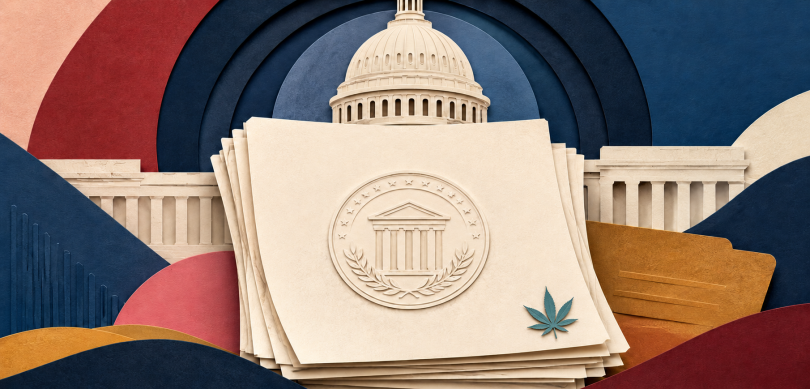
Section 781 of Public Law 119-37, signed on 12 November 2025, makes three changes to the definition set by the 2018 Farm Bill.
It switches to total THC. Hemp has been defined by delta-9 THC alone — no more than 0.3% by dry weight. The new standard counts total tetrahydrocannabinols, including THCA, the non-intoxicating acid that converts to delta-9 when heated. That single change is what makes high-THCA flower non-compliant. Our guide to reading a certificate of analysis shows how labs calculate the total-THC figure.
It caps finished products at 0.4 mg of total THC per container, and also reaches certain cannabinoids with effects similar to THC. Note that is per container, not per serving. A 10 mg gummy is 25 times the limit on its own; a jar of twenty is 500 times.
It excludes cannabinoids made in a laboratory rather than grown. Two categories are ruled out: compounds the cannabis plant cannot produce at all, and compounds it can produce naturally but which were instead synthesised outside it.
That second category is the significant one. Delta-8 THC does occur in cannabis, but only in traces far too small to extract commercially — so the delta-8 sold in shops is almost always made by chemically converting CBD in a lab. Under the new definition, how a cannabinoid was made matters as much as what it is. Commercial HHC and many other converted cannabinoids would also be caught, although precisely which statutory category some compounds fall into may depend on the FDA’s forthcoming cannabinoid classifications.
Who this affects
The intoxicating hemp market — delta-8, THCA flower, high-dose gummies and beverages — is the obvious target. The US Hemp Roundtable, an industry body, estimates that around 95% of hemp products currently on the market would fail the new standard.
But CBD buyers should not assume they are unaffected. The US Hemp Roundtable estimates that more than 90% of full-spectrum CBD products currently on sale exceed the 0.4 mg per-container cap. Full spectrum retains trace THC by design, and a per-container limit that low catches many products that are neither marketed nor ordinarily used as intoxicants.
CBD isolate products, and broad-spectrum products verified to contain no detectable THC, are less likely to be affected. Broad spectrum is not automatically compliant, however: even a small residual amount can exceed 0.4 mg across an entire container. Industrial hemp grown for fibre and grain is unaffected.
Where it stands
Updated 8 September 2026; corrected 28 September 2026.
The delay is done. On 1 September the House passed the stopgap government funding bill 370–48, accepting the delay language the Senate had approved 90–6 in August, and the President signed it the next day. The provision had been added to the funding bill at the White House’s request — a move that visibly irritated Republicans who had voted for the ban less than a year earlier, and some of whom voted against the funding bill over it.
The result, in practice:
- 11 December 2026 is the new date for most of Section 781 — the total-THC standard, the 0.4 mg per-container cap, and the exclusion for cannabinoids the plant can produce but that were synthesised outside it. That last group includes commercially made delta-8. Until 11 December, products that qualify as hemp under the 2018 definition remain federally lawful.
- 12 November 2026 still stands for one narrow category: products containing cannabinoids the cannabis plant cannot naturally produce at all. The delay does not cover them. Which compounds belong in this group is not fully settled — HHC is the one most often disputed — and the FDA’s forthcoming cannabinoid lists are meant to settle it.
The new date is not an accident of drafting. 11 December is also the day the government funding measure runs out, which puts the hemp question inside the next funding negotiation. That is the industry’s window to argue for regulation rather than prohibition — and the opposition’s window to see the ban through.
What this means if you buy CBD
Nothing changes today. Products that qualify as hemp now continue to qualify under the 2018 federal definition until the new standard takes effect.
After that, if you use a full-spectrum product, there is a reasonable chance it will be reformulated or withdrawn. CBD isolate and verified THC-free broad-spectrum products are the safer bet for continuity. Our guide to full spectrum, broad spectrum and isolate explains the differences.
Worth keeping two things separate, because they are routinely confused. Qualifying as hemp under this definition is one question. Whether a product may lawfully be sold as a food or supplement is another — the FDA’s position on CBD is unchanged by any of this, and remains that CBD is excluded from the dietary supplement definition.
State law is a third layer again. Some states already apply total-THC measurement and per-serving caps; others will see a sharp change. Our state-by-state guide covers where CBD itself is already restricted.
What happens next
Congress has until 11 December to do one of three things: pass a regulatory framework for hemp cannabinoids, delay again, or let the ban take effect. Several pending bills would regulate rather than prohibit; none has moved past committee. Industry groups are lobbying hard for that outcome. Opponents of the delay — including some Senate and House Republicans, and the marijuana industry — want the ban to proceed as written.
A one-month delay resolves nothing on its own, and White House officials had earlier indicated they would not seek a further one. Whether that holds inside a December funding negotiation is anyone’s guess.
We will update this article as it moves.
Sources
- Congressional Research Service, Change to the federal definition of hemp and implications for federal enforcement — the statutory detail, including the FDA’s obligation to publish cannabinoid lists and define “container”.
- Marijuana Moment and The Hill on the 8 August Senate votes.
- The Hill, 1 September 2026, on the House vote.
- Forbes, 3 September 2026, on the signing.
- Fox Rothschild and Akerman client advisories, September 2026, on the scope of the delay and the synthetic-cannabinoid carve-out.
Correction, 28 September 2026: an earlier version of this article said commercially made delta-8 and similar converted cannabinoids lose their hemp status on 12 November. Under the enacted delay they follow the 11 December date; 12 November applies only to cannabinoids the plant cannot produce at all.
This article covers United States federal law and was last updated on 28 September 2026. Rules differ by state and by country, and this situation is changing quickly — check the date on anything you read about hemp law, including this page. Nothing here is legal advice.