
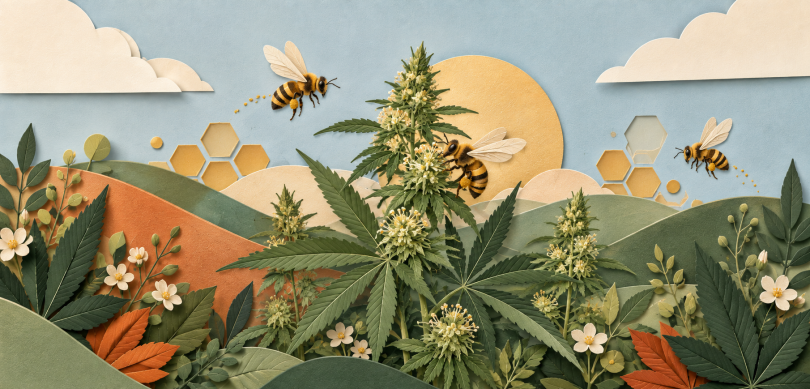

Bees visit pollen-producing hemp even though cannabis does not need them. Cannabis is wind-pollinated: it produces no nectar and does not offer the usual sugary reward that attracts pollinating insects. So when hemp and bees end up in the same field, it isn’t the plant’s design at work — it’s the bees making do with what’s on offer.
What’s on offer, specifically, is pollen from the plant’s male flowers — female cannabis flowers ordinarily produce no pollen, so an all-female field grown for cannabinoids may not offer bees much at all. Where male flowers are present, though, it turns out to be worth something. A 2020 study from Cornell researchers, published in Environmental Entomology, surveyed bees visiting hemp fields in New York and found 16 different bee species foraging on hemp pollen — a real range of species, not just honeybees. The more interesting part is the timing: hemp flowers late in the summer, during a stretch when many other flowering plants in the agricultural landscape have already finished blooming. For bees hunting pollen during that seasonal lull, hemp is potentially useful supplementary forage. It’s not a complete diet, though — a later study of hemp pollen’s nutritional makeup found it likely isn’t adequate as bees’ only pollen source, so it works alongside other forage rather than replacing it. The same 2020 study found that taller hemp plants were associated with more abundant and diverse bee visitors — a real correlation, though the study doesn’t establish why height matters to the bees.
None of this means the bees are getting high. In humans, THC produces its intoxicating effects mainly by acting on cannabinoid receptors, CB1 and CB2. A 2001 study found no specific cannabinoid-receptor binding in honeybees or four other insect species, and found no corresponding receptor genes in the fruit-fly genome. A THC-like high in bees is therefore not expected.
Because hemp provides pollen but no nectar, it cannot be the nectar source for a single-source hemp honey. Honey produced near a hemp field might contain some hemp pollen, but its sugars came from other flowering plants. “CBD honey” sold in shops is generally ordinary honey to which CBD has been added afterward.
For growers, the practical concern is wind-blown pollen, not bees. Pollination produces seeds and generally reduces floral yield and cannabinoid concentration. Growers protect cannabinoid crops by removing male plants and separating fields from pollen sources; managing bees will not stop pollen arriving on the wind.