

Last updated 18 September 2026 · Originally published 1 July 2021
Learning how to cook with CBD oil mostly means learning three things: what heat does to CBD, why fat is its friend, and how to know how much actually ends up in each serving. None of the three is complicated, but all three are regularly gotten wrong — including, in places, by our own earlier articles on this subject, which this guide replaces.
First, why bother. Cooking with CBD is a way to fold it into a routine you already have, avoid inhaling anything, and make taking it more pleasant than a dropper under the tongue. Those are real, modest reasons. Anything grander than that belongs to the health claims we cover — carefully — elsewhere, not to a recipe.
Heat: what we actually know
Our earlier articles gave maximum cooking temperatures that disagreed with each other, so we went looking for the actual research — and the honest finding is that it does not give us a precise maximum oven temperature. In one laboratory test, pure CBD isolate began losing mass above roughly 140–150°C (284–302°F). That was CBD powder heated directly during a rapid temperature test, not CBD mixed into food.
A separate experiment heated pure CBD at 175°C (347°F) for 30 minutes. Much of the CBD remained, but some changed into other compounds, including about 4.5% delta-8 THC and 2% delta-9 THC. That experiment has not yet been published in a peer-reviewed journal, and it did not test CBD oil, cake or cookies.
An oven set to 350°F does not mean the CBD inside a cake reaches 350°F. Moist food remains much cooler than the surrounding oven air, particularly while it still contains water. Ordinary baking is therefore likely gentler than directly heating pure CBD to the same temperature, but nobody has measured exactly how much survives in a typical recipe.
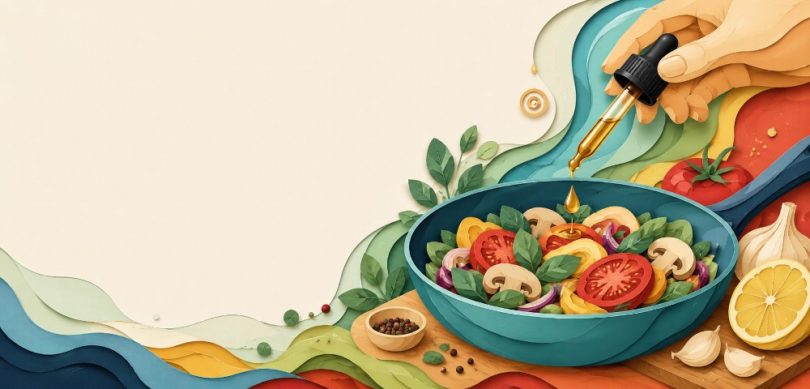
The practical advice is simple: mix CBD thoroughly into the fat and batter, avoid exposing it directly to the heat of a frying pan, and add it after cooking when the recipe allows. That preserves the dose with the least uncertainty. And use only a product intended to be swallowed — vape liquids, skin oils and massage products do not belong in food.
Fat: why every recipe starts with butter or oil
CBD dissolves in fat, not water, which is why recipes route it through butter, coconut oil, olive oil or cream rather than juice or broth. A fatty carrier keeps it evenly mixed, and eating CBD alongside fat also substantially improves how much of it your body absorbs — the one part of cooking with CBD where the kitchen genuinely works in your favour. Expect some grassy bitterness from full-spectrum oils; chocolate, citrus, herbs and spice all mask it well. Butter for baking and oil in dressings remain the two easiest routes in.
Dosing math: know what you made
The method is one line of arithmetic: total milligrams of CBD added, divided by number of servings, equals milligrams per serving. If you stir 480 mg of CBD into a batch of 24 cookies, each cookie carries about 20 mg — as an average. Two caveats make that “about” load-bearing. Mixing is never perfect, especially in thick batters, so the cookie from the edge of the bowl and the one from the centre can differ meaningfully in what they actually contain; mix the oil into the fat thoroughly before it meets the dry ingredients. And the math only tells you what you made, not what you should take — how much CBD makes sense for you is its own question, with no single right answer, and typical retail servings sit well below the doses used in most clinical research. Finally, the math is only as good as the bottle’s label, and CBD labels are wrong often enough that checking the certificate of analysis before you cook with a product is not paranoia, it is step one of the recipe. One more thing that COA settles: if you use full-spectrum oil, its THC is divided among the servings too — cooking does not remove it or make the finished food drug-test-safe.
Nothing in this article is medical advice. If you take medication or have a health condition, talk to a healthcare provider before adding CBD to your food — and keep homemade CBD edibles clearly labelled and away from children and pets.